Read your birth chart
Astrology aspects: angles and orbs
An aspect describes the angular separation between two planets in a chart. Learn the five major angles, see how an orb works, and check the arithmetic with simple examples.
The five major aspects
The angles below are conventions of Western astrology. Their names describe geometry; the interpretive themes are symbolic traditions, not demonstrated forces or predictions.
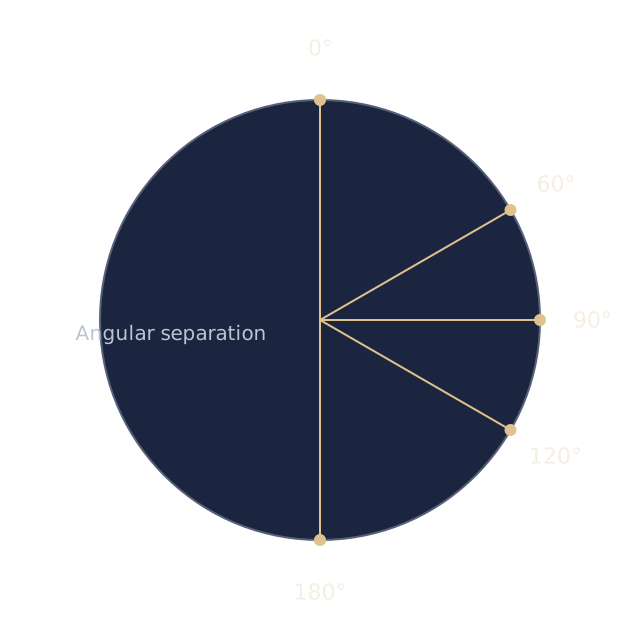
| Aspect | Exact angle | Traditional theme |
|---|---|---|
| Conjunction | 0° | Combining or concentrating two planet themes |
| Sextile | 60° | An opportunity for cooperation |
| Square | 90° | Tension that invites a practical response |
| Trine | 120° | Ease or familiarity between themes |
| Opposition | 180° | A contrast to recognise or balance |
A square does not mean that something bad will happen, and a trine does not guarantee success. The planets, the wider chart and the school of interpretation affect how astrologers read a pattern.
What is an orb?
An orb is the difference between the measured separation and an exact aspect angle. A separation of 92° is 2° from a square at 90°. Whether it is included depends on the threshold used by the chart software.
Our birth chart calculator uses one fixed 6° threshold for these five aspects, including a pair exactly 6° away. This is a transparent display choice. Other software may allow different orbs by planet or aspect, so its table can differ without the underlying planet positions being wrong.
The output is ordered by the smallest orb first. That indicates closeness to the geometric angle, not the likelihood of an event or the quality of a relationship.
Calculate an aspect, step by step
- Convert each placement to a longitude from 0° Aries: Aries starts at 0°, Taurus at 30°, Gemini at 60°, and each next sign adds 30°.
- Find the absolute difference. If it exceeds 180°, subtract it from 360° to obtain the shorter angular separation.
- Compare that separation with 0°, 60°, 90°, 120° and 180°. The distance from an exact angle is the orb.
| Example placements | Longitudes | Shorter separation | Result with a 6° orb |
|---|---|---|---|
| 10° Aries and 12° Gemini | 10° and 72° | 62° | Sextile, 2° orb |
| 29° Pisces and 1° Aries | 359° and 1° | 2° | Conjunction, 2° orb |
| 0° Aries and 6° Cancer | 0° and 96° | 96° | Square, 6° orb; included |
| 0° Aries and 7° Cancer | 0° and 97° | 97° | No major aspect within the chosen threshold |
The wraparound example matters: 359° and 1° are only 2° apart, even though their numerical difference is 358°. Adding the same sidereal offset to both planets does not change their separation.
Aspects versus sign compatibility
A whole-sign pairing compares signs by their place in the twelve-sign sequence. A natal aspect compares the actual degrees of two planets in one chart. Two planets in traditionally square signs need not be close to a 90° aspect.
Comparing planets between two people is usually called synastry. This calculator reports one natal chart and does not calculate synastry or a compatibility percentage. The sign compatibility guide explains the separate, broad symbolic approach used on this site.
Read your chart without a birth time
Without a reliable birth time, the Moon may move enough during the day to change its aspects. The rising sign and houses also cannot be established. Our unknown-time option shows noon planet positions and omits the aspect table, rising sign and houses instead of presenting an uncertain result as exact.
The position wheel uses 0° Aries at the top and clockwise zodiac longitude. Its dots show calculated positions; numbered labels are separated for readability. It is a visual aid alongside the text table, rather than an ascendant-oriented house wheel.
Frequently asked questions
Are aspects the same as houses?
No. Aspects compare angular separations between planets; houses divide the chart into areas used for interpretation. Our calculator uses whole-sign houses when a birth time is known.
Why does another calculator show more aspects?
It may use a wider orb, minor aspects, extra chart points or different options. Compare the planet longitudes and thresholds before concluding that either calculation is wrong.
Does a square predict a bad relationship?
No. A geometric category is not evidence that a relationship will succeed or fail. Behaviour, communication and circumstances provide more useful information.
Sources
Updated · How we write and check this guide